[lead_text]
Issues
[/lead_text]
- Narrow footway widths on busy pedestrian areas
- In some cases it is very hard for two people to pass each other without one venturing onto the road.

-
This (narrow footways) causes me to avoid certain streets

- Minimum footway widths do not work in a crowded environment as mobility impaired people and wheelchair users, or those with pushchairs or buggies have no option but to use the carriageway. So access off and on to the footway at frequent intervals is a necessity.
- High kerbs to footways and lack of dropped kerbs cited as a major problem by most respondents. High kerbs can be trip hazards for those pushed to the edge of the footway. Safe zones are considered to be raised footways with kerbs and people want to be able to get back quickly on to this area. Dropped kerbs are required at frequent intervals along footways.
-
Dropped kerbs or absence of are a problem throughout Bath. Quite often you get one at one side of the road and then there isn’t a corresponding one on the opposite side.
-
- Often dropped kerbs are not highlighted. This affects people moving along the footway who cannot distinguish the dropped kerb and also car drivers who park alongside and block it.
- Dropped kerbs can sited in the wrong place to give a clear view to the other side of the street or of approaching traffic.
- Obstructions on footways such as A-boards are a particular problem in tourist areas. Other footway obstructions include cafe seating, sign posts.
-
A-Boards were a significant issues but since new local legislation came in the situation has improved
-
Often cars parked on pavements not allowing room to get through and also parked on dropped kerbs
-
Obstacles on pavements are hard to negotiate as I cannot move things out of the way myself
-
- Perpendicular car parking with overhanging bumpers on the footway are a particular problem creating a low level hazard for visually impaired people using the kerb line as guidance and restrict footway width.
- Bollards used for traffic management are a trip hazard and restrict footway width.
- Footway cambers that are steep are difficult for mobility and visually impaired people and a hazard for wheelchair users and those attempting to push them.
[lead_text]
Examples
[/lead_text]
- Westgate Street narrow footway widths and crowding on footways force more vulnerable users onto the carriageway where they are exposed to motor traffic danger.
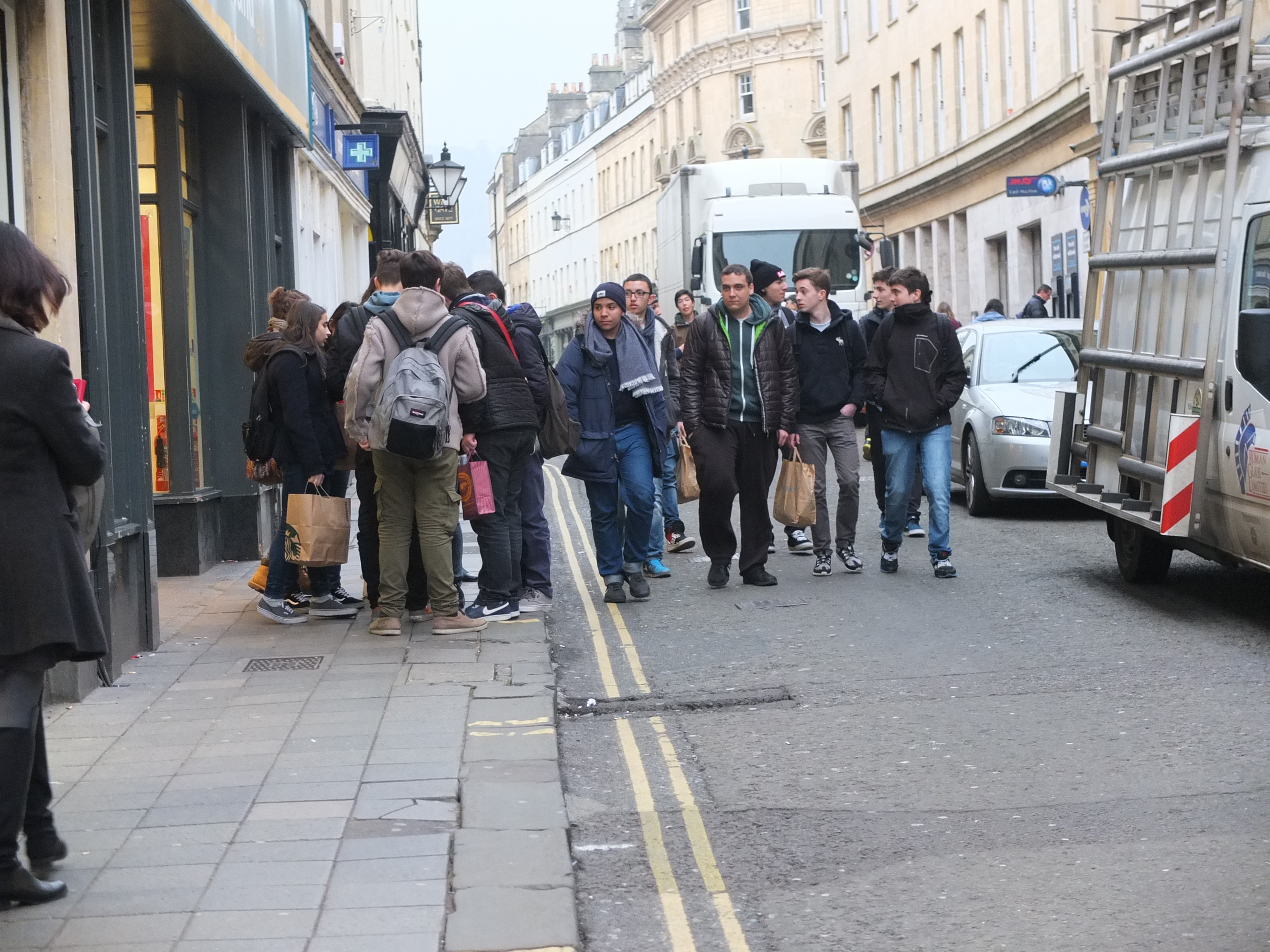
- Westgate Street most commonly cited as footway with insufficient dropped kerbs. Access to popular Boots and Superdrug shops is restricted because of this. ‘Not able to get into Superdrug shop because of lack of dropped kerbs. Tried to find a dropped kerb so went up Union Street along Upper Borough Walls past Theatre Royal, eventually found one on corner’.

- Upper Borough Walls has no dropped kerbs
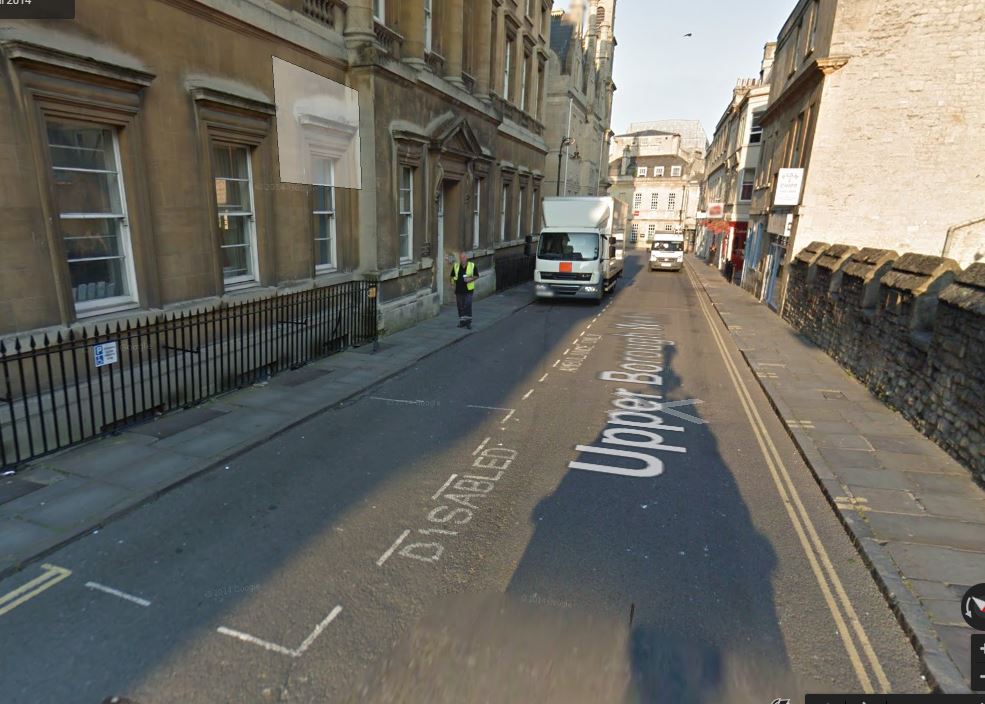
- The dropped kerb at Somerset Street is used by wheelchair users to get to the ramp to get to the car park across, so it is in a critical location. This affects both visually impaired people and wheelchair users.

-
‘Dropped kerb is usually blocked by parked cars. Road surface is bad. Path too narrow, Forced to go onto main road to use crossing’.
- Near the train station while the footway is wide on Manvers Street, people dragging suitcases or using wheelchairs have to slalom between road signs, A-boards and café furniture.

- Combination of oversized A-boards, signposts and bollards on the footway (Upper Borough Walls and Lower Borough Walls)


- Superfluous bollards at entrance to Bridewell Lane at Westgate Street.

- Overhanging car bumpers on Walcot St


- Road signs are placed in the centre of the footway, when there is a park to the side where the sign could be placed, or other method used to provide information without obstructing and inconveniencing pedestrians. (Green Park Road)

- A-boards

- This shop on street off Kingsmead Square has an overhead sign that is very visible, but two A-boards on the footway in addition to café seating. As the footway is the only smooth section of the road with the carriageway cobbled, this makes it even more difficult to negotiate.

- Bartlett Street provides a route to Milsom St and to the popular pedestrianised Southgate centre and the Mineral Hospital. However, it is a narrow vehicular street with narrow footways each side. Bollards on the footway further restrict footway width. Cobbles on the carriageway make using this surface particularly difficult. The junction with George St does not provide adequate dropped kerbs with tactile warning paving.

- Queens Square: footway surrounding the Square is very narrow permitting only single file walking and is further hemmed in by a row of parked cars. Allocation of footway width appears to be determined by need for car parking rather than for pedestrian comfort. The footway also has a steep camber.


- Manvers Street, the main gateway from the train station to the city centre has a footway that is interrupted by the Manvers Street car park crossovers for entry and exit. Both these crossovers create steep cross falls along the footway making it almost impossible for anyone on wheels to maintain their line, and is also difficult for people with mobility or visual impairments to negotiate. It is dangerous for pedestrians as gives implicit priority to outgoing and incoming vehicles over pedestrians passing on the footway. There is not tactile paving provided.

[lead_text]
Recommendations
[/lead_text]
- Progressive review of footways and expansion of pedestrian safe areas in every public realm scheme
- More effective enforcement against A-boards.
- Overhanging car encroachments are easily prevented by placing bumper restrictor strips on the carriageway.
- Seek alternative methods of traffic control other than bollards. CCTV, restriction of cars on certain streets.
- Kerb heights should be minimised to prevent tripping. A 50-60mm kerb is low enough to prevent tripping, but is detectable by majority of people with sight loss.
- Visually contrasting kerbs and carriageway materials or lines should be used to improve delineation for people with sight loss.
- Dropped kerbs should be provided at frequent intervals and as a minimum at every side road crossing. Dropped kerbs should mirror each other at crossing points.
- Dropped kerbs should be protected from car parking by clear markings and effective and prioritised enforcement.